

The Club Car Jam

Updated: Mar 23

If you have gone to the "About" page, you may have read a little about my love of music and trains, and about the magic at Fir, which is at the top of La Veta Pass, a remote place reachable only by train, where some of the most amazing music happened.
The meadow at La Veta Pass was where the music opened up, and the club car was where it came back together again.
The car itself was something special before a single note was played.
Car 3305, the Mardi Gras, was the original club car from the City of New Orleans, the train made immortal by Steve Goodman's song, which included a verse about this club car.

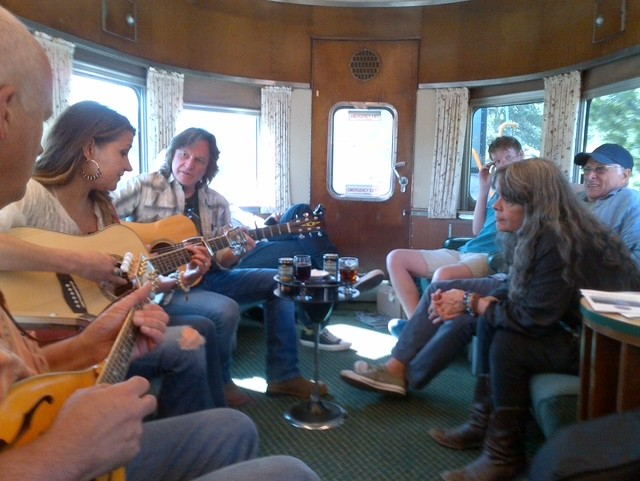
It had a wood-paneled interior and a bar set right in the middle, dividing the space into two halves. The back of the car was rounded, with curved windows that looked out over the track behind the train. During the day we didn’t need much lighting. The sun did most of the work.

It was filled with overstuffed chairs, the kind you sink into, and it held maybe forty people if you used every seat. There were booths on either side of the bar, and the whole space had a warm, welcoming feeling. Not tight. Not formal. Just comfortable.
On the way up the mountain, the club car had a different rhythm. Passengers who paid extra sat in the front half. The performers rode in the back. Some of them would walk the length of the train, greeting people. That could take a while. We might have 150 people on the train, sometimes as many as 600.
The concert itself happened up in the meadow, outdoors, at the top of the pass.
The club car came alive on the way back.
After the last song had been played, after the merchandise had been packed up or sold, people would make their way back up the path and reboard the train. There was a kind of quiet satisfaction in the air. The day had already delivered what it promised.
And then, without much planning, something else would begin.
Fred Hargrove, who hosted the concerts, and I would take out our guitars. Fred would start a song. I would join in. Sometimes we joked that when we first met, the only song we both knew was “Red River Valley” That didn’t last long.
Fred’s repertoire leaned western. Mine leaned folk. Over time, we traded songs. I learned “Colorado Trail.” “Old Cowhand.” He picked up “This Land Is Your Land.” “If I Had a Hammer.” It wasn’t a set list. It was a shared language that kept expanding.
At first, it was just us, and we didn't sell tickets in the club car. People just came in to buy a drink. Or out of curiosity.
Then they started to stay.
They would drift in from the rest of the train, find a chair, or stand nearby. They didn’t always sit down right away. They lingered. Listened. And then, almost without thinking about it, they began to sing along.
That was the moment I started to realize something was happening.
After a few trips making music in the club car, I told the bartender to try to sell a few more drinks. After a few more trips, it occurred to me that maybe this was something we should be charging for.
Not because it was exclusive, but because it had become intentional.
The first real jams were completely spontaneous. Fred and I would play. I would join him on a couple songs. And then, more often than not, the artist would wander in.
Michael Martin Murphey was our regular main act in those early years, and he took to it naturally. He would sit in, play a few songs, take requests. People would ask for specific Murphey songs, and suddenly you were sitting a few feet away, hearing them in a way you never would in a larger setting.

That changed the dynamic.
At that point, I told our agent in Nashville that if we were going to keep building this, we needed artists who were willing to take part in the club car jam. Not everyone wanted to do it. But most did. And the ones who did understood what it was.
It wasn’t a performance.
It was a moment.

Songs moved around the room. Requests came in. “Wagon Wheel” was a regular. My daughter Emily, who worked on the train and played guitar, would take that one and do it beautifully. People sang. Not as an audience, but as participants.
By then, the line between performer and listener had mostly disappeared.

The train would be rolling back down the mountain, the light starting to shift, and inside that car, forty people or so would be sharing something that couldn’t really be scheduled or repeated in exactly the same way twice.
Looking back, I don’t think we built the club car jam.
I think we noticed it, and then we made room for it to happen. And I'm glad we did.


Comments